First published: 11 Apr 2012
The famous yellow pumpkin of Naoshima.
A constant flow of sightseers proved to be an ongoing accompaniment.
One of the most famous islands in the Seito Inland Sea is Naoshima, a part of Kagawa prefecture and only a short ferry ride from the coast of my own Takamatsu City. Having visited Shodoshima on two occasions prior, I was interested to see the other islands in the area and to discover what they had to offer. With my newfound commitment to see at least one new location in Japan every month, I determined that Naoshima should be next on my travels, to kick off what would prove to be a very fulfilling March.
Naoshima had attracted me early on during my time in Takamatsu, but thus far had escaped me. It is frequently found on many travel lists, variably "places you need to see before you die" or "places in the world you must see", etc. The island was highly spoken of by my fellow ALTs, and appeared to be famous across Japan on a scale completely removed from it's modest scale. The island was renowned for it's natural beauty, and it's world class collection of modern art collections - supposedly some of the best in Japan, featured in a 2010 Seito-wide art exhibition. This trip was to be my opportunity to discover the island for myself first-hand. Heading over for the weekend beginning March 3rd, I left my home early on Saturday morning and found myself stepping out onto the port of Naoshima a few hours comfortably before midday.
The weather was perfect; a warm, sunny day which signified that - at last! - Spring had arrived and the Winter chills were receding into memory (something for which I was very grateful).
The gorgeous coasts of Naoshima.
My friend and ALT colleague, Richard Kinsella, had kindly offered to be my tour guide for the weekend. Richard is a fellow Scotsman from the infamous city of Glasgow, and the only ALT based on Naoshima. Having been the island's sole ALT for the last three years, Richard was well-versed in the many attractions of the island, and therefore more than qualified to offer me a detailed and unique insight. Additionally, Richard had offered his home to me as a place to stay overnight - a great opportunity to spend more time with this warm-hearted fellow countryman.
 Richard Kinsella on Naoshima.
A fellow Scotsman, and the island's only ALT.
Richard Kinsella on Naoshima.
A fellow Scotsman, and the island's only ALT.
Richard's calm demeanour seemed perfectly in sync with the island, with it's laidback tone and its friendly locals. Richard, as it transpired, appeared to be something of a local celebrity on Naoshima - many people instantly recognising and waving warmly towards him during our travels. While I'm certainly well known around my home Takamatsu (such is the inevitable curse of the 'gaijin'!), the denser population perhaps makes it somewhat easier to hide. By contrast, Richard seemed to have acquired a very unique position indeed, prominent and yet appearing completely at ease within this small community.
The isolated nature of the island and it's gorgeous coastline appeared reminiscent of cinematic exotic locales, usually seen in movies like James Bond (in fact, standing by the coast, the Seito Inland Sea bore a remarkable resemblance to Scaramanga's hideout in The Man With the Golden Gun). The island was suburban in nature; a calm escape from the hectic city life, while still close enough for easy access to the city and all of it's extravagances. Life on Naoshima really did seem to be the best of both worlds, and I reflected that Richard was a very priviliged individual indeed.
After a brief stop at Richard's impressive abode to drop off my bags (a sizeable home to which my small apartment pales in comparison!), the first order of business was - of course - lunch. Strolling through the small residential streets of the island in search of a restaurant, I observed the modest homes of the island residents. Naoshima is a relatively small island, yet these wide townships - full of rustic character - were abundant and widely spread. I had no idea that Naoshima was so populated, and just how many people actually lived here, yet it was easy to see the attraction.

Nyaoshima! An example of Japan's famous cat cafés.
Customers don't just go for the food; they go to play with cats, too.
Our plan for the day was to visit the island's reknowned art museums that I'd heard so much about. I have always had a small connection with art - studying it in high school, and spending a great deal of time sketching and doing pastel work in my teenage years (I've always been a terrible painter, however). Over the years, I've enjoyed visits to a few exhibitions, and have occasionally been fascinated by some of the work of artists displayed within them. I can, however, occasionally be rather cynical about parts of the culture that surrounds art - call me jaded, but I have on occasion encountered a small degree of pretention and elitism with a few art enthusiasts, which I have found off-putting and opposed to the expressive aims of the mediums. However, the inhernet expression in art can be something that reveals a lot about a culture and an individual, and a fascinating spectacle in it's own right. I was determined to go, and see these much lauded exhibits for myself. Iwanted to know just what they consisted of, and why they were so damn famous.
For Richard, of couse, there was an added bonus - he had studied graphic design and visual communication at his university! The man had most definitely landed on his feet in coming here.
Swaying diamond shapes! These incredible objects are just
one example of the wealth of modern art that covers the island.
After finding most of the restaurants that Richard recommended to be closed before midday, we settled upon a small cafe which served a set lunch consisting entirely of vegetables and rice. As a predominantly carnivorous eater, I was surprised at how satisfying this lunch was - the vegetables, rice and soup all treated in such a delicious way that it was only later that I reflected there wasn't a trace of meat within those dishes.
A delicious tray of traditional Japanese food.
And - surprisingly! - not a drop of meat.
I was actually so impressed by this restaurant that I bookmarked the location on my iPhone. I shall definitely be returning here upon my next visit to Naoshima.
 Some friendly faces pop up in an alleyway on Naoshima.
Walking along the streets, we made our way up to an impressively large shrine area. Walking up a large area of stairs through a forested area, we came into a grand courtyard where I stopped to take as many pictures as I could.
A pleasant uphill climb to the shrine.
A gorgeous shrine on Naoshima.
Despite determined Google searching, I am unable to find it's name.
Richard suggested that we move swiftly on - it was after midday, after all! With a sudden epiphany, I agreed. This area truly was a terrific spectacle, but admittedly a familiar one. Shrines like this are common across Japan - even within walking distance of my own home! - and I realised that I was here to sample what made Naoshima so unique, and in danger of accidentally missing it in favour of a more traditional Japanese experience.
And so, onwards.
Menacing dogs guard the grounds of the shrine.
I found their expressions more than a little unsettling.
We didn't have to walk very far to sample some of Naoshima's artistic character, however. Only a few feet onwards sat the Go'o shrine - an old Edo-period shrine restored by the famous Japanese photographer Hiroshi Sugimoto. This was remarkable. The shrine is connected to an underground chamber via a unique glass staircase (they look like giant Fox's mints!), whilst the restoration of the exterior has a distinctly modern flair (surrounded by huge white pebbles).
The Go'o shrine, as restored by Hiroshi Sugimoto.
A breathtaking blend of the old and the new.
This structure is immediately striking; the glass staircase blends effortlessly with the traditional Japanese architecture, and the fusion is entirely unlike anything I'd seen thus far in Japan. Richard has been informed via rumour that the glass is the same variety used to construct camera lenses, though neither I have no means of verifying this information. The chamber supposedly leads to some beautifully framed images of the horizon, yet unfortunately Richard and I decided we had no time to spare, and so moved on (again, one for the return journey).
Those stairs just look so... delicious! Minty fresh, undoubtedly.
Having hired some bicycles at the ferry port, Richard and I cycled towards the famous art museums of the island. However, though the museums were not so far from our location, the journey to them was an uphill one, forcing us to abandon our transport by the coast. Luckily, this proved to be a great opportunity to see the famed yellow pumpkin that sits on one of the piers.
From peaches to pumpkins...
Okayama's fruit obsession appears to not be an isolated occurence.
This object, simply called 'Pumpkin', was made by Yayoi Kusama - an artist who (from my limited research) apparently harbours a pumpkin obsession from her childhood as her family grew hundreds of them. Intriguing. This work is a stark juxtaposition against the natural surroundings, yet to my mind just looks absolutely fantastic for the simple colour and brightness it adds to the scenery. It was constantly surrounded by admirers posing for photographs (though I did not stop to get one myself - we were on a mission, after all!).
One of Richard's priviliges of his position as the island's only ALT is free access to the art museums for himself and companions. After a long walk uphill, Richard and I finally arrived at the base of the Chichu Art Museum. Picking up our tickets from the ticket office (
gratis! A Scotsman's dream!), we contined up a large hill whilst I looked around for the museum building in vain. It was only when we reached the entrance that I realised the amazing feat of construction before us; this museum was contained entirely within the hill.
The Chichu Art Museum; built inside the hill.
An amazing feat of engineering and design.
Image sourced from here.
The Chichu Art Museum is part of the Benesse Art Site on Naoshima, an area full of impressive art exhibitions. It is a relatively new structure; only opening its doors in 2004. The entire structure was designed by the Japanese architect Tadao Ando, and was designed to be a fusion between the natural and constructed worlds. The museum uses cleverly positioned openings in the ceiling to allow natural light to filter in and illuminate most of the exhibits, while the architecture of the building itself is one of the central works on display; the off-angled passageways and pointed shapes creating a bewildering labyrinth that plays with your head. The museum contains only a few select pieces of artwork; including classic impressionist paintings of water-lillies by Claude Monet (presented in a stark, bright white room), as well as contemporary displays by James Turrell and Walter De Maria.
These latter structures are breathtaking to behold. Walter De Maria's strange and monolithic black orb sits midway down a neo-retro staircase, completely at odds with the angular shapes around it. Elsewhere, the multiple James Turrell exhibits are unlike anything I'd ever seen. Featured are a room which changes colour with the natural light of the day (making for a rather impressive array of postcards!), as well as a huge open room filled with neon light that completely defies all understanding of perception, accessed through a hole in the wall where it initially appears only to be a mounted colour panel. Remarkable.
I should also mention that the Chichu Art Museum has a beautiful garden featuring around 200 of the flowers featured in Claude Monet's paintings - the aim being to increase immersion and appreciation for his paintings by observing the flowers in their natural environment and allowing the audiencce a more contextual understanding. This was quite a unique and - in my opinion - admirable approach; the garden reinforcing the expressive ambitions of the museum, rather than simply being a separate part of it.
I'm afraid I'm not much of an art critic, but I can say with complete sincerity and enthusiasm that all of these exhibits made a huge impression with lasting, memorable images. Unfortunately, photography was banned inside the island's art museums, and as such the following images have all been sourced from various websites;
Image sourced from here.

 Images sourced from here.
The stunning exhibits at the remarkable Chichu Art Museum.
Images sourced from here.
The stunning exhibits at the remarkable Chichu Art Museum.
This place was simply unlike any art exhibition I'd ever seen before.
This remarkable building isn't just for those who might be interested in contemporary art or architecture, but anyone who wants to experience a unique and slightly bizarre experience where you can see breathtaking and inspiring things in an environment completely outwith your normal world. Thoroughly recommended.
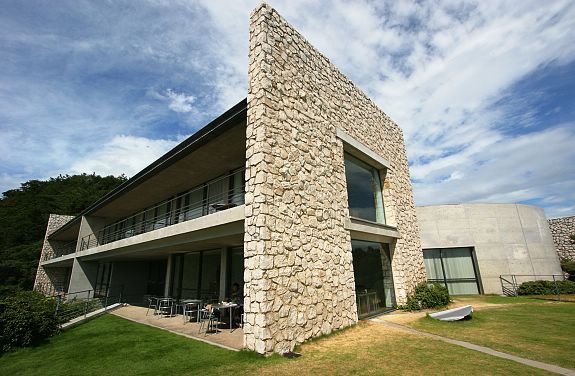
Leaving the Chichu Art Museum, Richard still had time to take me to two more of the art museums located in the Benesse Art Site. The first of these was the Lee Ufan Museum; first opened in 2010, and this time a fusion of the artwork of Korean painter and sculptor Lee Ufan with the architecture of the aforementioned Tadao Ando. However, I couldn't help but feel a twinge of slight disappointment - the grand displays of the Chichu Art Museum simply weren't matched by the displays here. This is not to say that the works within them were of a lesser quality (there were certainly some unique and interesting ideas in here - such as a false shadow cast by a rock which contained a projected video image!), but they lacked the scale and shock of it's close neighbour, and accordingly, it was hard not to feel a bit sorry for this museum - so completely over-shadowed. I would recommened visiting this museum before the Chichu, so that it's exhibits may be appreciated before one has his senses obliterated.

The Lee Ufan Museum: an impressive art collection,
but sadly overshadowed by it's immediate neighbours!
The next location, however, piqued my interest right back up again.
Image sourced from here.
The Benesse House: hotel and art museum wrapped into one.
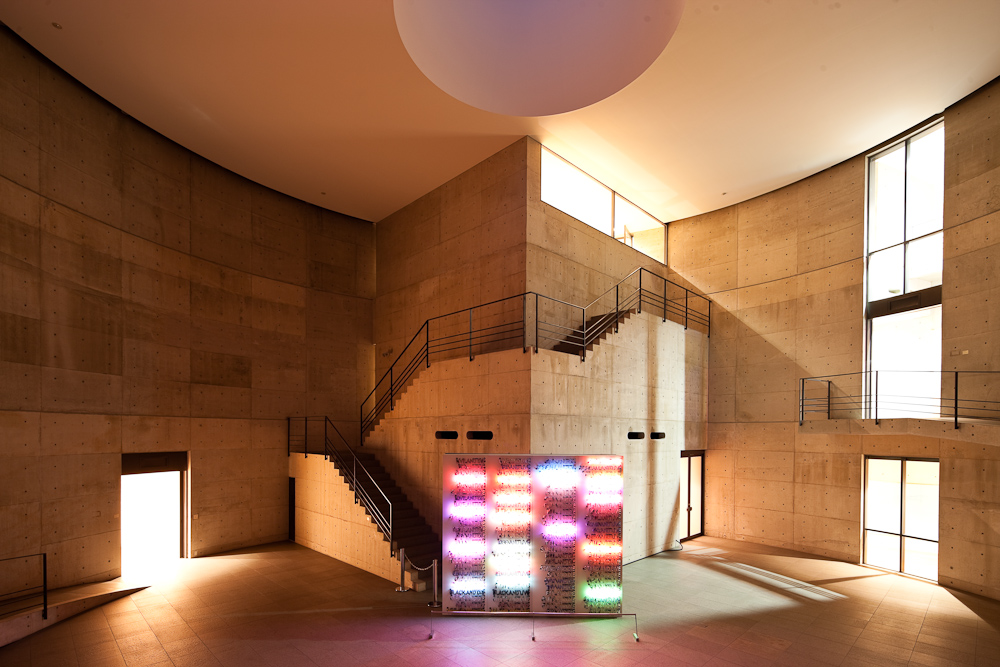
Benesse House, opened in 1992, is a remarkable fusion of both art museum and hotel (?!). Once again designed by the architect Tadao Ando (this guy sure keeps busy), and again high up on the peak of a large hill, the museum is spread across multiple floors with loads of distinct and quirky exhibits full of vibrance, variety and charm. The scale of this place is huge - in fact, I honestly didn't know where to start exploring it! The edges of the buildinng were mostly all framed with huge class windows, allowing a wealth of natural light and the chance to see the goregous views of the Seito Inland Sea. A nice cafe upstairs also offered the charming aroma of fresh coffee whilst overlooking a beautiful area of the coast.
There were some amazing exhibits in here; such a selection of world flags composed entirely of sand, which were subsequently altered as a colony of ants (!) transformed them and made them their homes. Strange wire outlines of men moved with rotating mechanisms to constantly chew with their jaws. A huge red circle reminiscent of the Japanese flag was created via an optical illusion, using using two mirrors and a sole quarter consisting entirely of uniform Ultraman figures. My favourite exhibit, however, was the strange black board which alternately lit up bizarre neon messages that announced various abstract, contradictory and often vulgar statements about life (ie. "Work and Die", "Eat and Live", "Shit and Live", etc. These exhibits were consistently bizarre, quirky, and fun sights to see, and it was impossible not to be completely won over.
Image sourced from here.
Image sourced from here.
Humorous and innovative artworks at the Benesse House.
Guests staying in the hotel suites are also granted 24 hour access to the exhibits - not a bad perk, it must be said! I have been told there is also a monorail service (!!) for guests to have easy access. I imagine staying here would be a thrilling experience.
To learn more about the amazing art museuems found on Naoshima as part of the 'Benesse Art Site', visit
http://www.benesse-artsite.jp/en/ - and don't worry, it's in English!
At times, Naoshima resembled something of a tropical paradise.
Retiring from the art exhibits, the sun was beginning it's descent in the sky, casting a warm orange glow over the island. Walking back along the coast, Richard and I walked down to a nearby pier to pose for some photographs and enjoy the beautiful surroundings, finding various artworks belonging to the Benesse Art Site and revelling in the natural calm along the way. The harmony between nature and architecture on this island was truly remarkable; the minimalist constructions complimenting the scenery instead of stifling it, and entirely opposed to the look and feel of nearby Takamatsu. The experience felt spiritually invigorating.
Richard plays with his shadow.
I should mention that Richard took the opportunity here to play a few practical jokes on me. Running to a series of loose diamond shapes, he pushed them as if knocking them over from their display. I froze in panic, only to discover the flexible nature of these shapes. Similarly, Richard used the unique perspective of a certain staircase to make it appear as if he was jumping over the edge of a cliff - again, causing mild hysteria on my part, until he casually strolled back up to the top. It was pretty funny, and I shall take note to do both of these tricks when bringing visitors here myself.
At last, Richard and I began what would be a long cycle back to the ferry port. As the sun was now setting and the day drawing to a close, we opted to take the ferry to Uno - a small town to the South of Okayama - for dinner, as most of the restaurants on Naoshima were ending their trade. Naoshima, as I have said, offers a fantastic network of transporation to both Takamatsu and Okayama, and we took advantage of this fact to access the variety of restaurants in Uno that evening (interestingly, we ended up settling on McDonalds there!). After browsing a few of the Uno retailers for video-games and manga (where I found a Japanese copy of Virtua Fighter 2 on Sega Saturn - which was, of course, purchased), and another brief stop for coffee (at which point I am certain I was short-changed, but was too embarassed to do anything about it), Richard and I returned to Naoshima on another ferry. This entire excursion to and from the island had been completed in just a few short hours. Incredible.


By the pier in Naoshima.
Returning to Richard's house, the evening was - of course - spent debating Star Wars and playing video-games on the Wii and PlayStation 2. Richard proved to be just as much of an avid gamer as I was, and we stayed up until the early hours with a determination to finish the last level of New Super Mario Bros Wii with two players (a feat finally accomplished some time around 3am). I also made a fantastic personal gain; Richard's PS2 to take home with me.
Richard had decided that this was to be his last year in Japan, after spending three years on Naoshima and keen to return to life in Glasgow. He told me that whilst he still had a strong affection for Japan, he felt the time had come to move on. Unfortunately for him, he had accumulated a great deal of material possessions during his time in Japan - including a PS2 with a large game catalogue! - and was trying to rid himself of much of them, only taking that which he considered the most valuable back to Scotland. Seeing my interest in a One Piece PS2 game in a shop in Uno, he offered me his PS2 to keep; he hadn't played it in years, and was happy to let it go. Having left my own PS2 back in Scotland, I accepted instantly, and found myself once again a happy console owner in my new home.
Thanks, Richard. You've made this gamer a very happy one indeed.


Richard and I take the opportunity for a dramatic pose.
After spending the night on a comfortable spare futon, we were up early the next morning, as I had to catch an early ferry back to Takamatsu. I had plans for later in the day on Sunday, and therefore could not afford to spend any more time on the island. Picking up a hot bento (lunch box) from the island's recently established Seven Eleven (something I couldn't quite believe was here), I made one final trip to the island's famous red pumpkin - a companion to the yellow one, which sits by the ferry terminal - though the weather was bleak, and I decided to wait until my return journey to take photographs.
Boarding the ferry, I bid farewell to Richard, and travelled back to my home in Takamatsu (side note; on the ferry ride home, I was accosted by a strange Japanese drunk who demanded to know my phone number. Slightly terrifying, but I managed to humour him enough so that he didn't stab me).
The sun sets on the coasts of Naoshima.
I simply hadn't had time to see all Naoshima had to offer. One attraction which I sadly did not have time to see on this visit was the island's
James Bond Museum (!). Naoshima featured heavily in a recent James Bond novel by Robert Benson named 'The Man with the Red Tatoo' (2002), sparking a connection between Britain's favourite secret agent and this Japanese island. Though supposedly quite a small showroom, this museum is apparently run with hopes of having 'The Man with the Red Tatoo' adapted into the Bond film canon. Additionally, I am told that the slightly bizarre
I Love Yu bath house (full of quirky and apparently erotic artwork - plus an elephant statue) is worth a visit, too! Like everywhere in Japan, I was sorry that I simply couldn't see it all, though Richard assures me I can call on him for another tour anytime. Hopefully, I'll be able to see both of these on my next visit.
Naoshima was a charming place; full of culture, artwork, and blessed with gorgeous natural scenery and a magnificent backdrop in the Seito Inland Sea. Not only did it's peaceful environment allow a refreshing break from the day-to-day life in Takamatsu City, it offered everything I could have wanted to have gotten out of a day trip - and far more, besides! - which demands a return journey at some point in the not too distant future (especially as my companion, Richard, will soon be departing in the months ahead!). I must again say thanks to Richard for his wonderful hospitality and gudiance; without his aid, I wouldn't have seen half of the wonderful things that I saw.
Cheers, mate. You're a legend.
Surpassing all of my expectations, Naoshima is a unique, calm, and inspiring experience. Far from being just an elitist art haven, it truly is a beautiful natural environment filled with human creativity that anyone in or near Kagawa should make their way to.