Showing posts with label manga. Show all posts

Sunday, 29 July 2012

An Introduction to 'One Piece'

One Piece!

As you probably already know, anime and manga are together one of the biggest cultural phenomenons in Japan. Essentially a very distinctive art and animation style, anime and manga cross a broad range of genres and stories: everything from eerie sci-fi cinema classics like 'Akira', to the infamously popular 'Dragonball' and 'Poke'mon' TV shows, to "adult" fiction with a great deal of saturation (make sure you keep that Google SafeSearch option "on").

Obviously, this style has become hugely popular in many parts of the Western world, and in high-school, I myself was addicted to a couple of these shows ('Tenchi Muyo' and 'Outlaw Star' were like my crack), though my interest did fade over time. While many shows continue to be popular in the West, particularly to a niche market, I've inevitably rediscovered the world of anime in Japan, and it's permeation of almost every aspect of the culture.

Undoubtedly, the most popular of those series is 'One Piece' - a brand almost completely unknown in the United Kingdom.


The Mugiwara Pirates!
The show's greatest asset: it's characters.

'One Piece' tells the story of a young man named Monkey D. Luffy and his brigade of 'Straw Hat' pirates, on his quest to become the new Pirate King by acquiring the legendary lost treasure known as the "One Piece" (hence, the title). As you can guess, the show takes place in a world mostly inhabited by pirates, and charts the crew as they sail the seas on their adventures. On their quest, they battle many other pirates and the Marine forces, and battle strong individuals who have acquired magical skills through 'Devil Fruits' - magical fruits that bestow those who eat them supernatural abilities. Despite having well over 500 episodes so far (having started in 1998), the series continues to have a strong following and is quickly becoming one of the longest running (if not, THE longest running) anime series out there.

The flag of the 'Straw Hat Pirates'.

The merchandise for 'One Piece' is everywhere and inescapable. Almost every shop you visit in Japan will have some branded accessory or item - from pencil cases, stationary and lunch boxes to candy, t-shirts, shoes and video-games... If you can think of it, chances are it has a 'One Piece' version out. The characters and their names were known to be within weeks of arriving in Japan, without having ever watched a single episode. This series is so well-known over here, that it is almost unavoidable.

Naturally, I decided to give it a shot, as a way of seeing what my students were so interested in. I have to say, it's a pretty damn good show.

 The latest opening sequence of the show. Currently on it's 15th iteration.

Beginning from the very first episode that aired in 1998 (!), I've been working my way through the series slowly, and have currently watched the first 149 (!!) episodes in order. It's taken a damn long time to get through, but I've been thoroughly enjoying it, and I'm intending to make my way through to catch up (though I might take a fair bit of time doing that). So far, it's made for a very interesting (and inconsistent) viewing experience. At times, the show is genuinely gripping and shows great moments of character growth as they move through layered arcs and fascinating locations. At other times, it drags like hell, occasionally taking ten or so episodes to finish a single fight scene (the notorious 'Dragonball Z' effect).

 Protagonist Monkey D. Luffy.
A fascinating and unique character, whose carefree manner
disguises his immense strength and deep loyalty to his friends.

So far, the good has far outweighed the bad, but it can be a very frustrating experience on occasion. The worst offender thus far has been a forty-episode or so arc set in the country of 'Alabasta', which took far too bloody long to wrap up and really wore down my enthusiasm.

Alabasta.
Forty half-hours of my life I'll never get back.

I've also picked up a few of the manga series, in order to practice my Japanese reading skills. So far, it's proven to be VERY difficult, as I struggle to slowly make sense of the first volume. Having acquired the first ten books, it'll be a while before I can make my way through it. The manga is written and drawn by the original creator, Eiichiro Oda, and as it came first, I suppose it can be considered the "canon" version of the storyline. I'll be interested to get involved and see some of the changes - in particular, there's a rather drastic additional piece of information in the first volume alone that occurs within the first few pages - it certainly took me aback when making my way through it. There's currently 66 volumes, so this will definitely be a long term project, but also one which will hopefully drastically improve my Japanese...

 
'One Piece' manga and magazines... Plenty of reading material here!

The best thing this show has going for it are it's characters. There's some absolutely delightful personalities in the mix here, with every character having both a gripping back story and a unique dynamic that they bring to the crew. The best parts of the show are the interactions between the cast members.


Particular favourites are Tony Tony Chopper (a reindeer who ate a 'human' fruit and is now fully trained as a Doctor), Zoro (a hard-as nails swordsman who fights with three katana swords), Nami (a hard-as nails and manipulative navigator who, refreshingly for an anime girl, is never subjugated to the role of a love interest) and - my personal favourite - Sanji. This guy is the crew's chains-smoking cook, who also happens to kick some serious ass while chasing after women. A great blend of bad-assery and comic relief, it's impossible not to love this guy.
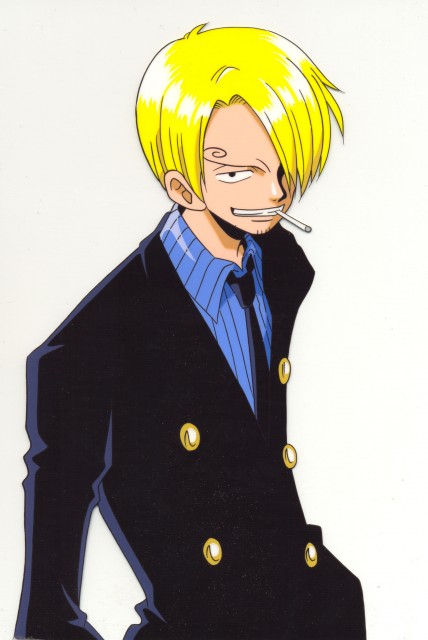
Sanji: Badass.

Of course, special mention also has to go to the wonderful protagonist. Monkey D. Luffy is a great character in his own right. Luffy is the definition of 'carefree': a simple man whose only joys are his friends, eating, sleeping, and adventuring. He has eaten the 'rubber' fruit, giving his body rubber-like properties, which appear comical but actually give him immense power and skill. Luffy's constant clowning around makes him a strange choice for the captain of a pirate crew, yet his greatest asset is in aquiring friendships and trust in those around him. As an inspirational and determined figure, Luffy fights tirelessly for his goals and strongly defends his "nakama", often fighting to the death for them. The show does a great job of balancing Luffy as a carefree clown and a fiercely inspirational pirate, and this unique characterization is truly distinct from anything I've seen before.

The show really makes you invested in the characters, and despite often lengthy lagging, you genuinely grow attached to them and want to see how they progress. Here's a particular highlight from a recent episode. In this episode, our hero Luffy battles Crocodile, a pirate with abilities not unlike Spider-man's Sandman:

Luffy vs. Crocodile, from the end of the Alabasta arc.
After forty episodes, my sheer joy at seeing their
excessively long feud finally end cannot be overstated.

If you've never seen any anime before, I'd recommend giving this one a shot. It's not all that bad, and certainly has a lot of interesting things going for it. It's characters and unique setting definitely make it an interesting universe to explore.

Just be prepared to have a lot of patience!

Sunday, 1 April 2012

A Brief Visit to Akihabara, Tokyo

First published: 14 Jun 2012

Akihabara had a lot to live up to.


A rainy day in Akihabara. Not particularly scenic!


Yakiniku!

One of the most famous divisions of Tokyo, it's name is synonymous with the neo-geek culture which is so fetishised by many Japan enthusiasts (the "otaku") internationally. This is the heart of Japan's manga, gaming and robot / hi-tech culture, filled with maid cafes and infamous for it's head-splittingly awful (and gargantuan) band 'AKB48' (if you don't know who they are, you've clearly never been to Japan).

A handful of the AKB48 crew. There's 48 of them, apparently.
I can't say they're my particular cup of tea...
(although this is definitely worth seeing!)

For Rainer and I, who would be staying overnight on our travel home from Tohoku, the change would be even more pronounced due to having just spent a week volunteering in a disaster zone. Unfortunately, Danny would be unable to continue travelling with us, as he needed to swiftly return home in order to fly off to Hong Kong with his girlfriend very shortly.

Rainer and I hadn't actually made any formal travel arrangements, beyond a vague "shall we go" / "mayhaps" discussion. Towards the end of the week, we were uncertain that we'd even be able to make it; we were just too exhausted from our work throughout the week. However, our fellow volunteers Michihiro and Yutaka - two Japanese friends we'd made during our time in Tohoku - happened to live in Akihabara, and invited us to meet them during our travel home. Having a new reason to go, we decided to do so.

Richard Gere promotes Orangina on the train to Akihabara station.

 
 An excited Rainer discovers a
Soy Joy machine at Akihabara station.

Having left Ishinomaki that morning and travelling on the Shinkansen from Sendai, Rainer and I had separated from Danny and arrived in Tokyo just after midday. Unfortunately, the weather had taken a turn for the worse, and as we made our way to Akihabara station, the floodgates had opened. The weather wasn't just raining, but blowing heavy gusts of wind as well; almost storm like in nature. And it was growing. Yet immediately, stepping outside at Akihabara station, the character of the place was overwhelming; manga posters draped every surface, while the outside area was filled with arcades, flashing lights and assistants handing out flyers for maid cafes.

Shifting manga posters on LCD screens dominate Akihabara station.

Rainer and I shared two opposing reactions; the first: "wow", the second: "find shelter! Now!". Yet, without having made any formal arrangements for accommodation, we presently had nowhere to drop our bags and hide.

The home of AKB48; an inescapable presence throughout Japan.

We settled for a back-up plan; running to the Gundam Cafe situated just outside the station, and pitching down for lunch. We battled our way through the storm (and past the notorious AKB48 Cafe, located right next door), and huddled under the entrance shelter while we waited to get in. After a few cold moments in the rain, we were inside.

Woah...

Now... I don't know much about Gundam. When I was a teenager, I used to watch the Gundam Wing series on Toonami back in the UK, and while I loved it, I didn't follow it obsessively or follow the story arc as a whole. I just liked seeing the cool robots. Something the Gundam Cafe had in spades. There were hundreds of these things.

...ROBOTS!!

The whole place was incredible; rather modest in size, but aesthetically, every aspect had been tinkered to parade the Gundam brand (even the toilets!). A massive TV directly in the centre displayed various clips from the anime series, as well as small behind-the-scenes documentaries of the inner workings at the Bandai factory where the toys are made. It was all a bit overwhelming, yet incredibly impressive.

The detail stemmed right down to the menu design.

Check out the detail on that carrot!
This place is legit.

We spent a great deal of time just sitting and taking in our surroundings. This was definitely preferable to the alternative, though, which was treading through the flowing waters outside. Before long, though, I had spent far too much money in the gift shop (on ceramic souvenir plates and hi-ball glasses, no less), and we were back on the streets - the weather still not letting up - in search of accommodation for the evening. With only an iPhone Maps App and a 3G signal as our guide, we navigated our way to a small hotel named 'Hotel Friend', where we found a room with two beds at a decent rate. Naturally, we chilled (and - as it happens - discussed our grievances with and discussed alternatives for the plot of the recently re-released 'The Phantom Menace').

After a prolonged rest (and a much-needed shower), we headed back in to a now thankfully rain-free town to catch up with Michiro and Yutaka.

We found our compatriots next to the station area, and despite having worked heavily throughout the last week, they seemed in good spirits and already revitalized. It turned out we were going to be joined by some more faces from INJM, including Chie and Mina (two local Akihabara girls and friends of our hosts), Eugene and Ayami (two of the folks in charge!), and Kayleigh (a British skiing instructor who was in her last week in depart Japan). Additionally, it had transpired that the legendary Alasdair Adams (fellow Scotsman and occasional star of these blog posts) happened to be in Tokyo and free that evening. A few swift text messages and we were making plans to meet him in the evening. Outstanding. For an unplanned trip, this was definitely coming together.

After recruiting Eugene and Ayami, we headed for the famous Yodabashi-Camera store. Rainer and I had already popped in for a brief look during the afternoon, but we'd only looked at iPads (and been horrified by the Star Wars Kinect game that was on display outside). Michiro was insistent; we had to see the upstairs areas, where toys and video-games were paraded en masse. I honestly wasn't anticipating what I was about to see...


Distinctly Japanese toys at Yodobashi-Camera.

It blew my mind. This place was huge. Several stories towered high and wide, packed to the brim with eccentric niche goods and gadgets. Nothing could have prepared me for the wealth on offer here; ranging from video-games and kid's toys to telescopes and camera lenses (and, of course, a heck of a lot more Gundam merchandise). I was in heaven.

I was particularly taken with an iPhone Dog...


There was so much to look at and investigate, that I found it hard to resist stopping at almost everything. However, hunger was beginning to creep up on everyone, and we left all too quickly. I settled for purchasing an Ultraman toy as my souvenir.

Next stop was yaki-niku at the Gyu-Kaku restaurant in a massive building by the station plastered with SEGA branding. If you remember from my first (rather lengthy!) blog post about Japanese food, you'll remember how much I raved about yaki-niku restaurants - essentially a form of indoor BBQ with flame-cooking at your own table. This was the first time I'd had a social yakiniku in a long time, as well as my first time at the Gyu-Kaku chain; apparently, it's rather famous across Japan and a few countries, but until had somehow gone completely unnoticed by myself! Much kudos to Ayami, who happened to be a vegetarian...


It was a good meal, with good company.
Dinner-time fun. From left to right;
Rainer Wessels, Takahashi Michihiro, Yutaka Iioka, Mina Kemmisaki,
Chie Aida, Eugene Amigo and Ayami Sasas.

Ayami enjoys a selection of fried vegetables, whilst
Eugene apparently enjoys the scent of chopsticks.

What would a meal in Japan be without
a bowl of rice in accompaniment?

We met Alasdair directly outside the restaurant, looking suave and in good spirits; top form, as per usual. At the girl's insistence, of course, we had to stop for a purikura moment.

I actually really like this photo. Note: Alasdair was not
actually part of the INJM team despite having the banner
positioned directly above his head!

After collecting Kayleigh Rumblelow (and her delightful Northern English accent) from the train station, it was time for drinks. Surprisingly, for a place of Akihabara's reputation, this proved to be much more difficult than initially anticipated. Most of the bars in Akihabara were shutting surprisingly early for a Saturday. I couldn't help but feel like we must have been missing a trick, but regardless, we made our way to a small 'British' pub where we sat outside for evening beveridges.

Sitting outside a 'British' pub in Akihabara. Relaxing, but
I'm certain there's a much more eccentric nightlife hidden nearby.

Alasdair and I were up for having a big night, and were determined to find a venue that would accomodate us. Everyone else, however, was beginning to wear down and feel a need to call it a night. Eventually, after a few fond goodbyes, the group whittled down to just myself, Alasdair and Kayleigh. Not even Rainer, whom I'd spent an entire week working in the trenches with, felt inclined to unwind with a few more drinks. It had been great to see all of our fellow volunteers again, and I was sorry that they wouldn't be with us for the rest of the evening.

Still, onwards!

We settled on sitting in an izikaya and drinking until four - not a bad decision, but certainly one that induced a sense of lethargy the following morning! Saying our goodbyes, I navigated myself back to the hotel with a dying iPhone battery and a dawning realisation that Rainer was an early riser.

And so it was, that waking up the next morning with a refreshed Rainer set the seize the day, I forced myself out of bed.

---

After a revitalising breakfast / coffee combination at Starbucks (a company and a brand that has never let me down), Rainer and I had only two things on the agenda; the first, was to return to Yodobashi-Camera and indulge in more of the previous evening's eccentricities, whilst the second was to visit 'Mandarake' - a retailer lauded as the largest manga store in the world (!).

 
 Manga: everywhere.

The weather was beautiful, and the streets were busy and vibrant, with a wealth of foreign tourists parading the streets. The maids were out in full force on the street, offering leaflets in their uniforms to rustle up trade. Incredibly, the streets had been closed and people walked openly across the ground. I was mesmerized by the amount of people walking around, and stopped to take a video:


Our return to Yodabashi-Camera went as expected, although this time I had an opportunity to indulge in my love of tripods and camera lenses, as well as play some of the Nintendo 3DS titles on display (turns out MGS3: Snake Eater doesn't work so well on a handheld!). Rainer picked up a strange set of magnetic steel balls that rolled around into different shapes, while I felt at home walking amongst all of the retro gaming titles and just roaming the aisles. It truly is a remarkable place, and well worth a visit for anyone in Akihabara.

Big demo booths in Yodabashi-Camera.
This guy must have been having a blast.

After popping through a few electronics retailers - Akihabara was full of PC hardware for sale! - we arrived at Mandarake. We actually waited in the wrong queue for the opening, as it turned out we were in the returns entrance. An entrance just for people who wanted to return items? What sort of place was this?! As it turned out, a spectacular one.

 A TRON mouse?!
Akihabara, I love you.

Anime advertising in every nook and cranny; here, an
anime girl gives instructions on how to install ASUS hardware.

Retro SEGA joy.

Mandarake was huge. Similar to Yodabashi-Camera in size - but not space (it was claustrophobic!) - every floor was filled with manga, video-games and toys. It certainly seemed worthy of it's reputation as the premier manga store; the window was full of old, archaic editions that looked like it was from very long ago. indeed.Of particular note was the starting discovery of a floor dedicated entirely to "adult" material, which happened to be filled with consumers, and a floor dedicated entirely to toys on the upper floor (where Terminators and Aliens sat side-by-side with Gundams and obscure-anime models).

For myself, the biggest surprise came on the gaming floor; a horde of Sega Saturn titles, all waiting to be purchased. I was elated; one of my ambitions when coming to Japan was to pick up a Japanese Sega Saturn, having always loved my European edition. Here was a good chunk of the titles I wanted right here. Buying as many as I could afford, I reluctantly left knowing so many more were being left behind (don't worry; I've since picked up the console in Japan courtesy of private sellers on the Japanese Amazon!).

Finally, after a cheap and easy lunch at the train station (chicken katsudon), we began a relaxing journey back to Kagawa. It felt like a very long time indeed since we'd last seen it, leaving over a week prior for our volunteering trip to Tohoku. I recall indulging in the luxuries of the Shinkansen food cart (coffee and snacks), and feeling relieved to know I'd be sleeping in my own bed again that night.

Akihabara was cool, but our stay had felt incredibly brief. We had only spent around 24 hours there, and there was so much more to see and do by reputation (for example, just what is up with these maid cafes?). Still, I got a taste for the place, and was enthralled by it. I'm looking forward to the inevitable return visit.

The good news is - thanks to our time in Tohoku with our fellow volunteers - I now have good friends there to go back to.

Thanks, guys.

Monday, 19 September 2011

Kyoto

First published: 30 Oct 2011

(Above) At the base of Fushimi Inari-taisha shrine, Kyoto (with Rainer Wessels).
(Below) Standing by the beautiful Golden Pavillion, Kyoto.

On September 16th 2011, I headed down to Kyoto for a long weekend.

Travelling with a group of friends, this was our first "big" trip since arriving in Japan, and we'd planned it for weeks in advance. Our team consisted of friends from all over Japan, having met at the JET Tokyo Orientation. We'd initially intended a very big group to come, but sadly so many had to drop out due to various work commitments and so on. However, we still managed to get together our group of eight people, and so we headed on down.

 We're in Kyoto!

Kyoto is famous in Japan for being one of the places to experience true Japanese heritage. Many consider Kyoto a sort of "spirtual capital" - a place where the essence of historical Japan has been preserved and where one can really go to experience the fascinating culture at the heart of this country. Of course, as newcomers to Japan, this was naturally a place we gravitated to - in our quest to truly get a sense of Japan at it's core.

 The controversial Kyoto tower;
a symbol of modernism in an otherwise historical city.

During our time in Kyoto, we managed to fit in some fantastic visits to amazing places rich in cultural history. On Saturday, our team made our visit to the famous Kinkaku-ji temple: the  Golden Pavillion. This beautiful 14th century Buddhist temple is exactly what it says without any pretension; it's golden (well, gold leaf anyway!). The current temple is actually a sort of reconstruction / restoration, as the temple burned down in 1950. Sitting in the middle of a beautiful garden in a large lake, it's a staggeringly beautiful sight to behold, and truly has to be seen to be believed.

 
The Golden Pavillion in Kyoto. Very, very pretty indeed.

Sunday's highlights included a trip to the Fushimi Inari-taisha Shrine - a fantastic walk up the beautiful mountain Inari filled with toori gates and long, winding paths on the way to summit. The Inari shrine is worshipped as a Shinto shrine for prosperity of business and wealth, and is the head shrine of Inari Okami - the kami (spirit/god) of these attributes. Amazingly, this shrine was established in the 8th century (!), and is still revered and worshipped today.
  
 'Cleansing' my hands before the journey to the summit.

I cannot describe the sheer beauty of walking through the lovely red toori gates. The path to the shrine contains the most staggering display of these archways that I've ever seen, all winding up in various paths through the mountain.


 The Toori Gates.

 
Rainer enjoys the scenery.

These toori represent a transition into the sacred - a gateway into a spiritual place. These, couple with the gorgeous scenery on display, makes walking up this mountain to the srhine a serene and beautiful experience. The walk is also juxtaposed with with beautiful small displays along the way - including places to stop and take 'wishes' on white paper, for example.

One of my favourite shots that I took on this trip!
Taylor Moyer takes a shot at Fushimi Inari Shrine.

 Taylor's recreation of the same shot.

This staggering display was definitely one of the highlights of our trips. I've had to show real restraint in uploading the photographs that I have - there were so many amazing things on this walk which I photographed, but to upload them all would make this blog post last for a very long time indeed! The historical nature of this shrine makes it a pilgrimage well worth doing for anyone interested in Shnto and historical Kyoto.

Of course, to my mind, it's wrong to think of Kyoto in purely historical terms.

  
Chilling with Pikachu!

He was kind enough to share some of his hats!

From the spectacularly large underground shopping mall that hides beneath the train station to the giant Pokemon walking around and greeting children, there's certainly a lot more to this city than it's past. While it's true that it's rich with cultural and historical heritage, from my experience it's also a vibrant city full of the energy and modernity of contemporary Japan, too.

To my mind; if it's got McDonalds, then it's modern!

On the Monday morning, of course, we had to head on home to our own seperate prefectures. Not before - of course - Taylor and I managed to fit in a small trip to the Kyoto Manga Museuem! A really fascinating place to learn all about the history of Japan's internationally famous art style and unique comic books. Needless to say, I took the opportunity to get myself sketched in manga style...

The likeness is uncanny!

I'm totally framing that on my wall.

Our time in Kyoto ran out all too quickly. We left Kyoto much in the same way we left Tokyo - happy and fascinated, but yearning to see so much more. There were so many things to do that we simply couldn't get done in the time we had.

Needless to say, a return visit is definitely on the agenda.