Sunday, 30 June 2013

Inujima

First published: 11th July 2013

Inujima.

Image from here.

Inujima was always something of a goal for me.

One of the many islands on the Seto Inland Sea - just off the coast of Kagawa prefecture - it is one of the many "art" islands and part of the Setouchi Trienale art festival. It has the distinction of actually being a part of Okayama prefecture (unlike Naoshima, Shodoshima, Oshima and Megijima in Kagawa prefecture which I had previously visited). The island is famous for copper refinery infrastructure which was closed down within a decade after it opened in 1909. The crumbling towers have been left intact on the island for visitors, with an interior facility converted entirely into a huge "walk-through" art exhibit.


The sea-wall and a lighthouse.


A crumbling copper-refinery tower on Inujima.

Inujima is notoriously difficult to access from Sunport, Takamatsu. It was originally the furthest away island from Takamatsu on the 2010 festival (though the festival has been extended in 2013 to more islands in the west), and as such had always held an elusive appeal to me. I decided it was worth making a trip to, and on Saturday 30th June, I did just that. Accompanying me were my lady-friend Angie Reynolds, frequent travel-companion Rainer Wessels, Julia Collie and Tetsuya Hongo, and Tomomi Andrez.

A long path leading from the ferry port to the refinery museum.

The Inujima team.

Travelling to the island was a big of a trek. To get there outside of Setouchi Trienale festival time, the quickest way we could discover from Takamatsu was to first take a ferry to Miyanoura port on Naoshima, then transfer to another ferry which made stops at both Teshima (another island) and, finally, Inujima. Unfortunately, the trip took around two and a half hours and cost around ¥4000 yen in total each way. A hell of a journey, and it was just as well we left in the very-early morning to arrive before lunch-time.

The skies were a little more grey than originally hoped, but we wouldn't let that spoil our day. We had actually set off with another companion; the ever-affable Dan Johnson. Sadly, when we discovered the high-cost of travelling from Naoshima to Inujima, Dan simply didn't have enough cash and opted to stay on Naoshima for a day of his own exploring. You can read about his own exploits in Naoshima in his three-part blog entries starting here. We posed for an obligatory shot at the the Naoshima red pumpkin before getting on our way - though there was only twenty minutes or so between our transfer, forcing us to sprint to the ferry port!


Once arriving (and having had plenty of time to play on my Nintendo DS), we finally arrived. Stepping into the ferry terminal, we found we could immediately buy our return tickets and tickets for the museum immediately. We actually found our first exhibit in that building; a thin screen with different videos of life across the island projected onto it from both sides. We started our journey with a gentle stroll down towards the Seirensho Art Museum. The island is incredibly small, and easy to travel by foot.

Julia and Rainer pose for the camera.

Bricks! The group comes to a halt to examine the ground.

We came to a halt in front of the entrance to the museum to find an area of ground and walls completely covered in brickwork. Pretty unusual. Rainer, with his background in engineering, was able to offer a quick analysis. The karami bricks were actually metallic, and had been composed of slag leftover when refining copper. They had already started to decay, and were clearly mixed in with bricks leftover from the construction of the smokestacks, too. There were many lying around which we tried to lift - they were actually pretty damn heavy.

Cobbled together.

Never before have bricks been this fascinating.

Bricking it.

We carried on to the entrance of the Seirensho Art Museum.

The Seirensho Art Museum, as previously mentioned, is a converted interior of the copper refinery. Every corridor has been stripped out and converted into a new, fascinating collection of exhibits that is on par with - and may be even better than - the stunning Chi Chu Museum on Naoshima (see my blog post on Naoshima for  more information on that amazing museum). The artwork was designed by Yanagi Yukinori, who you can read about on his personal website here.

A smokestack emerges from the roof of the Seirensho Art Museum.

The 'Solar Note' exhibit at the entrance of the Seirensho Art Museum.
Kanji characters dangle down around a box in the centre.

The bulk of the museum is composed of one winding corridor that uses mirrors to create a surreal experience, as an exhibit known as the 'Icarus Cell'. With an image of the sun on the wall behind you, and light directly in front of you, it appears as you walk down the first brickwork corridor that you are heading towards an exit. It becomes clear, as you approach, that you have to turn a corner. Turning, the light appears to now be coming from directly in front of you, while the sun is now directly behind you. The corridor plays this light-trick around every corner, and feels akin to being inside the video-game 'Portal'. One turn presents you with a glass panel that appears as if you're staring directly outside at a window. After a moment's realization, you quickly realize you're actually staring at a reflection of the sky. It's trippy... and amazing.
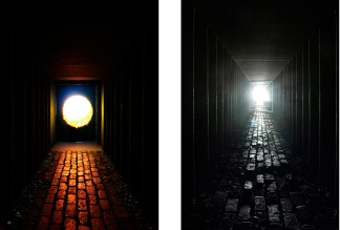
The winding corridors of the 'Icarus Cell'.
Image taken from here.

A little further into the museum are art displays that present parts of the interiors of houses, levitating in mid-air. These exhibits, 'Solar Rock' and 'Icarus Tower', are quite abstract but visually striking. They really do leave quite a remarkable impression. There was also an exhibit known as 'Slag Note' which showed a recreated interior of a home, where the shelves have been decorated with electronic appliances and plug sockets.
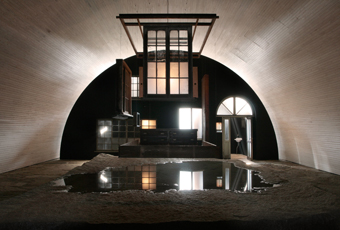
Solar Rock.
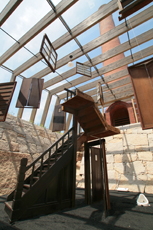
Icarus Tower
Images sourced from here.

The museum also included the 'Mirror Note' exhibit, which projected light against two mirrors to create a Matrix-style wall of running Japanese text on each wall. It was really quite remarkable... and we couldn't help but stick our faces and bodies into the beams to have the characters projected onto us!
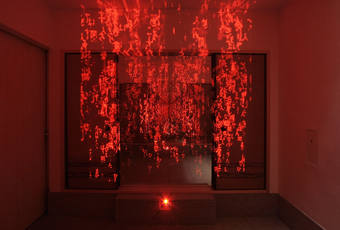
Mirror Note.
Image taken from here.

The museum also featured a cafe, but it was too early in the day to stop for lunch just yet. However, we found ourselves caught there as elderly Japanese woman stopped to try to explain to Tetsuya (in Japanese) the composition of the bricks and the history of the factory. Passionate about her subject, she spoke for about twenty minutes while we nodded and smiled. Tetsuya, an US American, understood most of what was being said, but the woman had clearly mistaken him for a Japanese guy and seemed shocked when Tetsuya explained he was actually from the USA.

We spent a little bit of time exploring the area around the factory. There were countless crumbling smokestacks across the skyline, and a beautiful quarry which sharp angles cut into the ground. Rainer described it best as looking a bit like a collapsed civilization. The decay and the resurgence of nature around it was really quite magical.

Crumbling smokestacks.

The group look out on the local scenery.

Quarry.

Tetsuya discovers a praying mantis on the path.

We spent a fair bit of time relaxing and messing around on the path, stopping frequently to admire the scenery. The day was hot - as usual in Japanese Summer - and it was approaching midday. We headed to a small local cafe with a surprisingly large menu on the walk back.

I was surprised by how many customers were actually popping in - it was thriving! The island seemed to be becoming immensely popular as the afternoon came in, and I was glad we had arrived early to beat some of the queues. A small problem occurred when Angie lost her phone, but it was swiftly recovered after being handed into the visitor centre.

Julia and Tetsuya.
Julia wanted to be lifted in order to see inside the well.

Chillin' with Rainer.

Tetsuya takes a moment to breathe.

After stopping for lunch, we took a bit of a break to relax by the coast. Everyone was feeling in need of a bit of a rest after the heat and the food. Rainer found a ball by the coast, which he and Angie repeatedly kicked into the sea to see who could kick it the furthest (the waves kept bringing the ball back for repeated attempts).

Angie and Rainer kick the ball into the waves.

Tetsuya's shows off his makeshift katana
while Angie struggles to control her hair in the wind.

We soon made our way around the other side of the island. Scattered in different locations were the various "art-house" projects, similar to those on Naoshima. There were some amazing exhibits scattered across the island. We were first struck by the F-Art House: a huge exhibit by Kazuyo Sejima, contained in a glass room which looked like a giant cauliflower had taken over a private residence. This exhibit was intended to reflect the origin of the universe, flowing out in different directions, and it was certainly an an impressive visual metaphor. The exhibit was conjoined to two rooms on each side, which were meant to represent the work of evolution as small shapes came together to form recognizable life. As an atheist I really appreciated the beauty being shown in this model of evolution, but it was somewhat negated when I accidentally banged by head on one of the doorways.

The F-Art House.
Images sourced from here.

Another particular highlight involved some glass structures which prevented the transfer of sound. It took a great deal of shouting when standing on one side to be heard on the other. It was bizarre to suddenly realize - without warning - that we couldn't hear what the people on the other side were saying.

Communication breakdown!

You could sing anything you wanted in here and not be heard.

Probably our favourite exhibit may have been the Nakanotani Gazebo, if only for the opportunity to rest our tired feet after walking!

The Nakatani Gazebo. A much-needed rest after being on our feet for most of the day!

The last two exhibits we encountered were something of an oddity. Both examples of the "Art House" projects, one featured a small movie called 'The Master and the Slave' which played on loop inside a house. The movie featured two men playing baseball with rocks, interspersed with cosmological imagery. It was very abstract and I'm not sure any of our party were able to interpret the author's intent or any other meaning from it (it was nicely shot, though). The other house project was a pale white room... with a window. And a garden. Not quite sure what was going on there, either. We must have missed something.

With the time for the departure of the last ferry approaching (a very early 3pm) We made our way back to the harbour area - but not before stopping to clamber over some rocks. Rainer particularly enjoys physical challenges like these, and made a mission of making it as far across the rocks as he could. We all got involved, though Tomomi thought it was a tad dangerous.

Fun on the rocks.


As we waited for the ferry, Angie and I decided to try some of the local "peach juice" being offered in the ferry terminal cafe. After all, as I mentioned before, Okayama prefecture is famous for it's peaches. Sadly, our order must have been confused, as we ended up drinking Ginger Ale.

Peach juice?

We drank more than half of our drinks each - both thinking that it was a very unusual peach flavour - before Tomomi and Rainer tasted the drink and realized what had happened. Oh well. Still, it was nice Ginger Ale.


A small ant statue rests on the wall of a local house in the village.


"Inujima" on the harbour wall.

3pm came, and we boarded the first of our two ferries back to Takamatsu. We were all a bit exhausted by the long travel time (another two and a half hours on boats), and most people fell asleep on the boat. That said, we all sat outside at the rear of the boat, and it wasn't long before we were all soaked - which certainly woke us up. When we arrived at Naoshima, we had just over half an hour to kill, during which time I decided to introduce Tetsuya, Julia and Rainer to the wonders of the James Bond museum and the locally-made Bond tribute movie "From Naoshima with Love". Disbelief certainly set in fast. An amusing end to a very enjoyable (but lengthy) day.

Bewilderment sets in with "From Naoshima with Love."

It may be a long journey to get there, but Inujima is highly recommended.

Inujima certainly isn't easy to get to if you're coming from Takamatsu. That's no reason not to come, though.  Our party had a wonderful day out, and I'd implore anyone to pop over to this little island - especially if you're coming from Okayama. It's a beautiful and peaceful little island, and a contender for having the best art exhibits out of all the exhibitions on the Seto Inland Sea. Check it out.

Friday, 28 June 2013

A Look at 'Hi Friends!' 1 & 2

'Hi Friends!' 1 & 2 by Tokyo Shoseki.
These English textbooks are used in elementary schools across Japan.

English education at Japanese elementary schools was formally introduced on a national level in 2011 for fifth and sixth year students. These students (aged around ten and eleven) usually study English for at least one hour every week - in most cases with an ALT, often from the JET program. The subject is not taught as a formal graded subject but as a a series of "additional activities", with formal academic study not being introduced until the Junior High School level. Despite English "activities" being a formal requirement, the vast majority of elementary school teachers have very limited English ability and have not been trained to teach it as a subject. In order to be able to facilitate this education, schools are supplied with the 'Hi Friends!' textbooks, which acts as a loose framework and a basic course of study.


The opening pages of the first book.

'Hi Friends!' is actually a replacement for the 'Eigo Noto' series, which were the first elementary textbooks to be widely issued in Japan and were widely in use until April 2012. I'm certain many schools are still using 'Eigo Noto' (though I don't have any statistics on the numbers), but by and large, 'Hi Friends!' is the contemporary teaching material. There are two books in the series; the first being for fifth grade and the second for sixth grade. Both books are actually significantly smaller than their predecessors, with a lower page count.

So, are they any good?

Well, the answer is basically "sort of"... ish.

The menu page projected onto a white-board.

An extract from 'Hi Friends! 2'.

The biggest problem facing the 'Hi Friends!' book as an effective teaching tool is the basic structure of English education within elementary schools in of itself. Since these books are introduced when the students are in their fifth or sixth grade (and are around the age of ten), it's a fairly late start to language learning. While some language classes may be provided for younger children between first to fourth grades, by and large these are very infrequent - usually several months apart - and those lessons focus almost solely on easy vocabulary. Of course, with most elementary school teachers lacking competent English abilities, it becomes easy to see why this became the case, though an intimidation factor is likely to remain for teachers tasked with teaching a language they have little to no experience in.

With no formal grading in place and most activities centered on fun ways to make English appear enjoyable rather than focusing on learning, it's natural that many kids simply won't take English seriously or experience much in the way of actual study. It's an inherent flaw in the system and something individuals hoping to use these books to seriously teach or learn from will find themselves in opposition to.

Having said that, the textbooks themselves aren't without merit.

A very good lesson from 'Hi Friends! 1' where students
watch videos of children across the globe introducing themselves.

Some lessons introduce a lot of new words at once.
This particular lesson is a bit of an info-dump!

Both entries in the 'Hi Friends!' series come are composed of a textbook and a CD-ROM companion which can be used through a computer and projector to liven up the lessons: showing large versions of the pages of the textbook; playing songs, videos, and audio samples of vocabulary; and being able to perform textbook activities in real time along with the ability to show the answers. There are also teacher editions of the textbook which provide all the answers and transcripts of most of the activities - though written in both English and Japanese, it can prove problematic for both English and Japanese speakers trying to decipher sections in a language they're unfamiliar with.

At only 56 pages each (with only 38 pages of actual classwork), these thin volumes are a pretty lightweight introduction to English education. By and large, the English language is very much absent in these pages. Passages where complete sentences are written are very anomalous. Almost all of the activities are explained in Japanese, which makes sense for children to actually understand what they're being presented with, but offers almost no opportunity for students to begin reading comprehension practice. There are almost no writing activities, and those that are usually are facilitated by teachers allowing students to represent English words through the Japanese katakana phonetic system rather than using the roman alphabet. Students learn the sound of the words, but they do very little in the way of learning how to read them. Roman characters are eventually introduced, but actual writing of them within the textbook activities is thin on the ground.

Students begin to read and write basic vocabulary in 'Hi Friends! 2'.
However, this exercise is one of the only times this happens in the series.

The course is composed of nine and eight "Lessons" respectively. Of course, the amount of content in each "Lesson" is usually too great for students to get through in one sitting while learning new English, and these "Lessons" typically span across several classes to complete. This is a good thing, as it allows opportunities to revise and go over recently-learned vocabulary repeatedly and cement understanding within the minds of the students. Typically, the structure of the textbook is very logical, though occasionally it can seem erratic and illogical. In 'Hi Friends!' volume one, it makes perfect sense to begin with basic greetings such as "Hello" and "My name is~", yet later in the textbook students learn the slightly rude-sounding "What do you want?" several lessons before "What would you like?". The difference in context isn't made clear, and it seems redundant to teach something so aggressive-sounding when used out of context when a much more pleasant alternative is only a few lessons later (and basically replicates the same meaning).


A strange repetition of a similar grammar point in 'Hi Friends! 1'.
I would argue that teaching both is unnecessary at this entry-level stage.

Overall, I would say that the basic structure here is sound, and - barring a few oddities - it provides a simple and competent framework to work from.

The pages are bright, colourful and appealing. The character designs are friendly and cute, and generally the production quality is high. There's no complaints on that front at all. The books simply look great.

A clear, colourful and effective design.
Very well-produced.

The activities themselves range from great to baffling. Some are very effective and straightforward, such as drawing lines or filling in blanks. A few more creative activities are included, such as colouring in a page of apples and asking your friends how many are coloured in. A few interview activities are also found in there, where students have to ask their friends for information to fill in the blanks. There's also a healthy dose of games included here (although there are less so in 'Hi Friends! 2'). All in all, these are many which are pretty good and have a good deal of variety. Some of the activities require cutting out pages of cards in the rear pages of the book. This can, unfortunately, take a little bit of time and distract from the lesson at hand.

Students can  follow directions around
a basic map (usually with a counter).

On the right: Cards to cut out for activities.
Make sure you have scissors!

Unfortunately, not all of the activities are of the same standard. One particular activity for 'Hi Friends! 1' is very peculiar. Colours and shapes are introduced through t-shirts being hung on a blackboard. The students have to listen to the characters say which particular designs they like. It seems a bit complex for the first formal introduction these concepts. The next page sees the book suggest that students design their own t-shirts, but it feels strange not to have a simpler way of denoting the colours before this activity. Having just studied fruits in the previous lesson, it seems like talking about those colours might have been a more natural progression. The pages themselves also look a bit drab and - ironically - colourless.

The t-shirt pages.

The "What's this?" pages are odd for challenging students to name items that they have never before been exposed to the vocabulary for. It is unlikely students will know how to say words such as "microscope" and "globe" in English without them being introduced earlier in the textbook. Equally, to introduce them exclusively for this lesson would defeat the purpose of guessing what each item is. It seems a bit odd, and students without prior knowledge of the vocabulary have stumbled at these pages. It would have made sense to have included more words that were previously introduced in the book, or to have shown full images rather than cropped ones. The choice of words is also a bit odd; I also don't understand why words like "beaker" are being introduced at this stage. Similarly, the first pages of "Hi Friends! 2" seem a little unfocused; numbers, the alphabet and foreign language words for "Hello" all share the same space on the page. It feels a little cluttered and unfocused.


Not convinced about these pages.

Praise must go the production quality of the CD-ROMs. Both are produced to a very high-standard and add a very nice visual companion to the textbook. The videos are generally of an extremely high quality and captivate children's attention effortlessly, often show insight into other countries and cultures. A particular highlight occurs right at the start of 'Hi Friends! 1', where students visually travel to other countries for around a minute of a time and get to see postcard-like impressions of Russia, Kenya, China, Australia, India and more. Children from around the world introduce themselves in both their native language and English. It's a great inclusion and a nice little reminder that English isn't the only foreign language. Another particular highlight is at the end of 'Hi Friends! 2', where students get to see the differences in school dinners in four other countries and contrast them with Japan's.

Kids from across the globe say "Hello".

This wee lad sounds pretty Scottish.

School dinners in the USA...

...and India! Though this particular shot isn't very flattering.
These videos usually go down brilliantly.

Less deserving of praise are the "chants". These probably don't qualify as "songs" since they're basically just little bits of music with English phrases attached, which the children are to "chant" along to. Some of these are fairly catchy, but some are simply downright bizarre. Most of the ones included here are variations of those originally found in 'Eigo Noto', but most of them have been modified slightly to run at a different tempo or rhythm in what I can only guess is an attempt not to directly replicate the same work. The results are mixed. Some are fairly harmless, but more than a few are a little awkward and difficult to stay in sync with. The pace is a little off and doesn't often flow naturally or as well as the originals in 'Eigo Noto'.

There's also one particular song in 'Hi Friends! 1' named "How many balls?" where I'm quite certain the male speaker is trolling. He pronounces "balls" with a heavy, camp lisp ("ballzzz"). I'm fairly certain it was an intentional in-joke. Maybe it's just me.

"It's a mat. It's a cat. It's a cap."
It's also crap.

The CD also offers the opportunity to watch a woman pronounce the English words and grammar individually. The speaker herself comes across fine and professional, though I've heard accusations that the smile is forced (I can't say I agree with them). I rarely use this feature, as most of the words have already been spoken within the activities. Additionally, due to the videos having such a prolonged focus, these videos have a slightly awkward tone. Though the speaker is not portrayed in a sexual manner, the extreme close ups of her mouth may inevitably carry some uncomfortable sexual connotations for teachers, which when coupled with prolonged direct staring at the viewer could create a pretty uncomfortable viewing experience (especially as the videos featuring her can be quite lengthy). I can't help but feel choosing a boy or girl (or both) of equal age to the target audience might have been a better idea - and definitely with the removal of the mouth close-ups. There are other young children in many of the videos, so it seems strange to suddenly shift focus to an adult.

This woman keeps staring at me.

Some of the content is prone to quite simply bizarre behaviour. For example, the "How many~?" lesson asks students to count how many legs are in the picture, even though the students have only learned up to the number twenty. Rather than simply not ask the question, the CD tries to make a joke out of it by having the speaker give up. Instead, it just comes across as odd, and the students are always confused by it.

Strange behaviour.

One lesson that should be discussed in detail is the "We are good friends" lesson. The opening pages ask students to identify as many nursery tales and iconic stories as possible within a two-page spread. The CD-ROM includes small snippets of the stories told in English language. A straightforward inclusion in of it itself, if a little cluttered.

Find the children's tales. This activity can be a bit difficult
for ALTs with limited knowledge of Japanese folklore.

Problems arise during the following story, which is a retelling of the Momotaro tale. The story should be familiar to anyone with an interest in Japanese folk tales, and is based right here in the Seto Inland Sea. Momotaro is a boy born out of a peach, who goes on an adventure with his animal friends to stop a tribe of ogres from terrorizing villagers. 'Hi Friends! 2" chooses to retell the story, this time using English grammar learned by the students.

Momotaro in (very) basic English.

The problem is simply that the students haven't learned enough English for the tale to really work. The students haven't had any meaningful reading practice up until now, so only students with prior knowledge would likely be able to read it. A version appears on the CD with spoken English phrases and a bit more movement in the pictures - I hesitate to say that it's animated as they're really just stills which move around a bit (there's also a small oversight in the layering that keen eyed viewers may notice when Momotaro's crew are on a boat). The English here is slightly more complex, and doesn't match the written words in the textbook. Thus it doesn't quite sync the way it's supposed to. The story itself also relies on prior knowledge of the story, as key moments are skipped over due to the lack of grammar (such as Momotaro's grand-parents - who are scared and begging him not to go on his quest - are happily preparing items for his quest in the next panel).

The concept itself is fine, but the way in which it is executed is a tad odd, and it makes you wish that more had been done up until this point to allow the students to read the story as it is being spoken to them. Of course, you can simply read the phrases to the students, but this negates the point of having a version on the CD. (Also, the voice-acting is a bit off. For some reason the dog sounds like a Texan, while the bird seems to be suffering from some form of anxiety.)

"A kibidango, pleeeeeeeeease!"
These pages are every ALT's worst nightmare.

There are obviously a number of complaints that can be levelled at these two books, but my personal biggest complaint is two-fold. Firstly, I think not adequately teaching students how to read and write properly using the alphabet characters they're learning is pretty silly, as it makes the whole point of learning an alphabet redundant. It also seems like a big oversight not to introduce fundamental grammar rules which are very swiftly avoided - such as using "a cat" instead of "cat", or differentiating between "cat" and "cats". These rules aren't terribly complex and would be adopted much more readily by junior high students if learned at an early age. I can say from my own teaching experience that Japanese elementary kids are more than capable of learning these rules, which goes a long way towards making life at junior high much easier. I suppose the biggest problem, of course, is that it most likely requires reading and writing practice to make these rules visible to students. You can't really have one without the other. A more substantial lesson on basic writing practice would be a very welcome addition in later revisions.

Due to the relatively recent introduction of English at elementary schools, there is an unfortunate degree of overlap between what is studied here and what the students will be studying all over again at junior high. Much of the content here is recycled in the early first year at junior high. The only difference is that here is that students don't have to write it down. When students go back to repeating grammar they've already learned and practiced at length, along with being reintroduced to the alphabet, it's quite likely to create boredom and a sense of lacking progression. Students at junior high moving into first year don't really seem to be picking up from where they left off, but rather just starting all over again. There is a real lack of integration between elementary school and junior high English education - something which could avoid several months of overlap if corrected.

This may also be highly subjective, but it seems there is also an element of patronizing students in here. Some of the students finishing 'Hi Friends! 2' are eleven and basically turn into young teengaers. It's a strange sight to see a boy with his voice breaking working from such a simplistic and child-friendly textbook. It feels as if the design should have slightly shifted to have been a bit less childish, though perhaps this is me looking at it with Western eyes. Larger-than-life illustrations are much more universally loved by Japan's young teens than in the West, so I may be well off the mark on this one.


Some of the best activities have a very international outlook.

Of course, a lot of these problems can be overcome by simply using 'Hi Friends!' as a structure and by not sticking to it as the only source of English education. Many English teachers at elementary school manage to do a fantastic job by adding to the system; adding in extra activities (including writing and reading practice) which really boosts the overall usefulness of the course. Schools that are fortunate enough to have specialized-English teachers and/or ALT visits can really use the basic outline of the course to create a much more nuanced and effective learning experience which can really be of substantial use to the students moving forward. In my experience, there are some fantastic English teachers working at elementary schools, who have managed to take 'Hi Friends' and do some great things with it. It should be clear that this textbook will not inhibit the abilities of a competent English teacher, and there are plenty of good ones.

If a school only has this textbook as it's sole resource, however, then it is definitely at a disadvantage.

Overall, 'Hi Friends!' is a reasonable introduction to English at elementary schools. It's bright, colourful, and there are some really good activities in here which really bring the English language to life for students. The videos on the CD-ROM are a particular highlight, and it's definitely a solid framework from which to build upon. The textbook  is fine as resource, but in of itself it isn't quite adequate for English "education". There are flaws, yes, but a lot of schools would be in a much worse position. In many cases this may be the only way in which English education can be facilitated, and if elementary English teaching is to be on a national level, having at least some basic structure is far preferable to having none. A lot of people like to slate  'Hi Friends!' (myself included), but it does have a clear function and a use.

My friend Eiji once described 'Hi Friends!' to me in a very concise manner. He asked; "I can only boil an egg for dinner. Would you trust me to write a cookbook?". While I can't comment on the English ability of the producers of these textbooks, it does make me wonder who is regulating and overseeing the teaching of English on a national level. 'Hi Friends!' fulfills its basic purpose, but it could also be so much more.

---

The 'Hi Friends' series is published by Tokyo Shoseki - formerly a video-game developer, and whose best-known work might be "Super Tennis" on the SNES. According to their Wikipedia page they stopped developing video-games in 1998 and are now focused on publishing "textbooks and educational software".